.svg)

.svg)
The architectural configuration of a single-product e-commerce brand—often referred to as a "hero product" store—presents a unique set of challenges that diverge significantly from traditional multi-SKU retail environments. The central inquiry regarding whether such brands require distinct Homepage and Product Detail Page (PDP) architectures, or if a consolidated "One-Pager" suffices, touches upon fundamental principles of Search Engine Optimization (SEO), User Experience (UX) design, and conversion psychology. While the inventory is singular, the customer journey is multifaceted, requiring a digital environment capable of supporting distinct traffic sources, intent states, and narrative arcs.
Research into high-performing single-product entities such as BlendJet, Truff, and Oura Ring reveals a definitive industry consensus: while a consolidated Single Page Application (SPA) architecture offers specific narrative advantages, it often falters in scalability and audience segmentation. Consequently, the optimal structure is a Multi-Page Application (MPA) comprising, at minimum, a dedicated Homepage for brand discovery and a Product Detail Page for transactional evaluation. This report provides an exhaustive analysis of this architectural dichotomy, detailing the granular sectional anatomy required for both page types—typically spanning 7-15 sections for Homepages and 8-12 sections for Product Pages—and synthesizing data from industry benchmarks, technical documentation, and case studies to prescribe a conversion-centric framework.
The foundational decision in building a single-product store is determining the URL structure and page hierarchy. This is not merely a design preference but a strategic choice that dictates traffic flow, ad relevance, and search engine ranking potential. The tension lies between the simplicity of the product offering and the complexity of the consumer decision-making process.
The "Hero Product" business model focuses all operational, marketing, and logistical resources on a single Stock Keeping Unit (SKU) or a very narrow range of variants. This focus allows for hyper-optimization of the digital experience. Unlike massive catalogs where the architecture is dictated by taxonomy and categorization (e.g., Men > Shoes > Running), the single-product site architecture is dictated by the narrative. The website does not need to help the user find the product; it needs to help the user understand the product.
In this context, the website serves less as a catalog and more as a sales letter. This similarity to direct-response marketing has led many to conflate the "website" with a "landing page." However, as brands mature, the distinction becomes critical. A "landing page" is a campaign-specific tool with a single focus, whereas a "homepage" is the brand's digital headquarters, serving multiple audiences from investors to returning customers.
The Single Page Application (SPA) model, or "One-Page Website," consolidates all content onto a single root domain (e.g., brand.com). Navigation links (About, Features, Reviews) function as anchor tags that scroll the user to specific vertical coordinates on the same page rather than loading new URLs.
The primary argument for the SPA model in a single-product context is narrative control. The brand dictates the linear progression of the story. The user is forced to consume the content in a specific order: Hook - Problem - Solution - Proof - Offer. This linear flow mimics the structure of a sales presentation, ensuring that the user does not skip to the price before understanding the value proposition. For high-ticket items that require significant education (e.g., Oura Ring), this controlled reveal can be powerful in the early stages of a brand's life cycle.
Mobile users exhibit a strong preference for scrolling over clicking. The physical interaction of swiping a thumb is less cognitively and mechanically demanding than tapping small buttons to load new pages. SPAs eliminate page load interruptions, providing a seamless "app-like" experience. This is crucial given that mobile traffic drives the largest portion of e-commerce visitors—up to 79% in some sectors. A single-page design capitalizes on this behavior by presenting the entire brand universe in one continuous stream, reducing the friction associated with site navigation on smaller screens.
From an SEO perspective, the SPA model offers the advantage of link equity concentration. All backlinks—whether from press coverage, social media profiles, or directory listings—point to a single URL (brand.com). This rapidly concentrates Page Authority (PA) and Domain Authority (DA), which can expedite ranking for the primary brand keyword. In the early stages of a brand launch, this can help a new site gain traction in search engine results pages (SERPs) faster than a site that dilutes its link equity across multiple pages with little content.
However, the SPA model faces significant headwinds as a brand scales. The primary limitation is SEO granularity. A single page can realistically target only one primary keyword theme (e.g., "Portable Blender"). It is mechanically difficult to rank the same URL for "Best Portable Blender" (commercial intent), "How to Clean a Blender" (informational intent), and "Smoothie Recipes" (navigational intent) simultaneously without diluting relevance. Furthermore, analytics become opaque. Traditional metrics like "Time on Page" and "Bounce Rate" lose their standard meaning when there is only one page. Tracking the user's progression requires complex event tracking (e.g., scroll depth percentages) rather than simple URL firing, complicating the data analysis required for conversion rate optimization (CRO).
The MPA model separates the digital experience into distinct URLs. For a single-product brand, this typically involves a Homepage (brand.com), a Product Detail Page (brand.com/products/item-name), and auxiliary pages (About, FAQ, Contact).
The strongest argument for the MPA structure is the ability to segment user intent. The Homepage can focus on "Brand Lifestyle" and broad appeal to capture top-of-funnel (ToF) traffic—browsers who are curious about the brand but not yet ready to buy. The Product Detail Page (PDP), conversely, can focus entirely on "Technical Specifications," guarantees, and conversion triggers for bottom-of-funnel (BoF) traffic—users who are evaluating the specific merits of the item. This separation allows the design of each page to be optimized for a specific psychological state: inspiration on the homepage and confirmation on the product page.
In the world of paid user acquisition, "Message Match" is a critical determinant of success. If a user clicks an ad about "The Founder's Story," they should land on an About page or a specific Homepage section. If they click a Google Shopping ad for "Black Portable Blender," they should land specifically on the PDP with the black variant pre-selected. Directing all traffic to a single generic homepage dilutes the relevance of specific ads, leading to higher bounce rates and lower Quality Scores. The MPA structure provides a dedicated destination for every distinct marketing angle.
Even single-product brands eventually expand their content footprint. Creating separate pages for blogs, recipes, or use-cases (e.g., BlendJet’s extensive recipe section) allows the site to rank for long-tail keywords without cluttering the transactional flow. A user searching for "Keto Protein Shakes" can land on a recipe page, get value, and then be guided to the product page. This "Side Door" traffic strategy is impossible to execute effectively on a single-page site.
The industry consensus for professional single-product brands is a hybrid approach that leverages the strengths of both models. The site maintains a Multi-Page Architecture (MPA) to support SEO and ad targeting but utilizes long-form, scroll-heavy design principles on both the Homepage and PDP to mimic the narrative engagement of an SPA.
The "Two-Page Core" structure:
Even if selling only one SKU, the optimal architecture requires a brand.com (Homepage) and a brand.com/product/sku-1 (PDP).
This separation ensures that the brand can speak to different audiences simultaneously without confusing the user journey. It allows the brand to separate the Story from the Spec.
Target Audience: Cold Traffic, Brand Searchers, Browsers.
Primary Goal: Education, Brand Affinity, Click-Through to PDP.
Typical Section Count: 7–15 Sections.
The Homepage of a single-product store must not merely duplicate the Product Page. It must contextualize the product within the user's life. It answers the question: "Who is this for and why does it exist?" rather than just "What are the dimensions?" The architecture here is designed to build desire before asking for the sale.
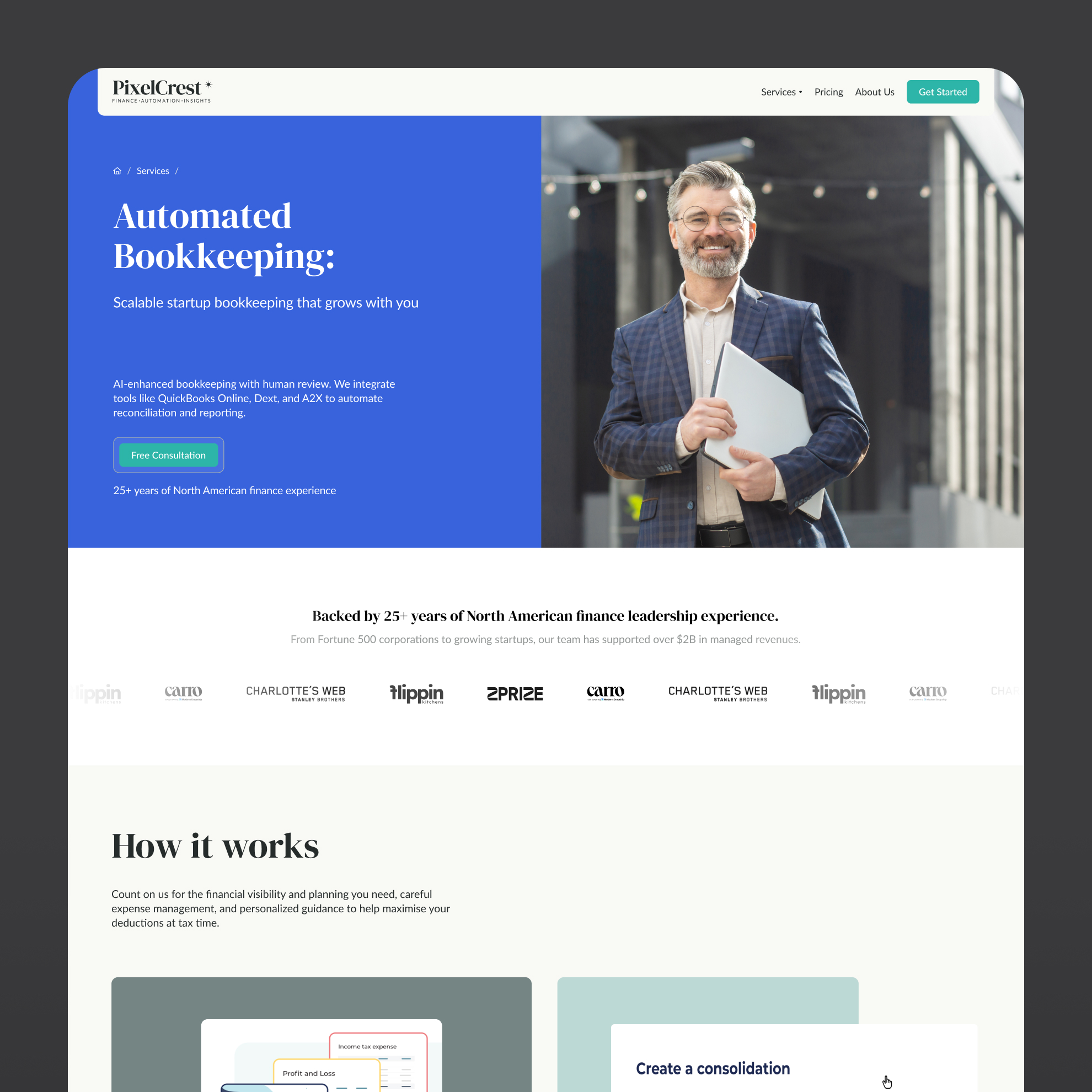
The "Above the Fold" (ATF) area is the single most critical real estate on the website. It must pass the "Grunt Test"—can a user understand what the brand sells within 3 seconds?
Immediately below the Hero, a "Trust Bar" or "Logo Strip" featuring logos of media features (Vogue, GQ, TechCrunch) or retailer partners (Target, Sephora) is essential. This leverages authority bias.
Before introducing the product's specific features, the Homepage must validate the user's pain point. This is the classic direct-response copywriting formula:
In a single-product brand, the "Why" is as important as the "What." Since the catalog is limited, the brand equity is tied heavily to the mission.
This is the "Shop" section of the homepage. Since there is only one hero product, this section acts as a preview of the PDP.
Single-product brands often need to demonstrate utility to justify the purchase. This section answers "When would I use this?"
Shoppers trust other shoppers more than they trust brands. A robust UGC section that aggregates Instagram/TikTok feeds or curated customer photos is vital.
Target Audience: High-Intent Shoppers, Retargeting Traffic.
Primary Goal: Transaction, AOV Increase (Upsells).
Typical Section Count: 8–12 Sections.
The Product Detail Page (PDP) is the "Moment of Truth". While the Homepage is about feeling and discovery, the PDP is about facts and confirmation. The structure here must reduce friction, eliminate ambiguity, and provide every piece of information necessary to close the sale. Industry data suggests that for single-product brands, the PDP must function as a "mini-landing page," containing enough persuasive content to convert cold traffic that lands directly on it.
Historically, PDPs in multi-SKU stores (like Amazon) are informational: Title, Price, Description. In single-product stores, the PDP must be persuasive. It effectively repeats the "Hook, Problem, Solution" narrative of the homepage but with a sharper focus on the physical product and the financial transaction.
The "Buy Box" is the transactional center of the universe. Its design correlates directly with conversion rates.
While the Homepage focuses on benefits, the PDP must satisfy the analytical buyer with specs.
The PDP should bridge the gap between digital and physical.
While the Homepage might show a curated feed, the PDP needs a searchable, filterable review database.
For a single-product brand, increasing Average Order Value (AOV) is vital for profitability, especially given rising ad costs. Since there are no other products to browse, the "upsell" must be engineered into the PDP.
To understand the optimal section count and structure, we must analyze the blueprints of successful single-product brands. These entities have iterated their designs based on millions of data points, effectively setting the standard for the industry.
BlendJet is the archetype of a single-product brand scaling through content and utility. They sell one core device (the portable blender) but have built a massive digital ecosystem around it.
Truff sells a commodity (hot sauce) at a luxury price point. Their architecture is designed to justify this premium pricing through "Prestige Signaling."
Oura sells a high-tech wearable that requires significant user education regarding sizing, sensors, and app subscriptions.
The decision to implement a multi-page architecture with deep sections has technical implications that must be managed to ensure performance and discoverability.
Most single-product brands operate on platforms like Shopify. Understanding the technical constraints is vital for planning the section count.
Strategic Allocation:
For a single-product site, the Sitemap (sitemap.xml) is naturally small. This presents a risk of "Thin Content" penalties from Google, where the search engine deems the site insufficiently substantial to rank.
/pages/our-story (Brand narrative and E-E-A-T signals)./pages/faq (Keyword rich Q&A targeting long-tail queries)./pages/ingredients or /pages/technology (Deep dive technical content that would clutter the PDP)./blogs/news (Ongoing content to signal site activity to Google and target informational keywords).Sitemap Visualization:
brand.com)./product/item), Checkout.Single-product stores often rely on "Impulse Buys" from social media traffic, which is overwhelmingly mobile.
The comprehensive analysis of architectural patterns, user psychology, and technical constraints leads to a definitive conclusion regarding the "One Page vs. Two Page" debate for single-product brands.
The optimal architecture is not a Single Page Application (SPA), nor is it a traditional thin e-commerce site. It is a Multi-Page "Landing Site" Hybrid.
Based on the case studies and conversion benchmarks, the recommended section density is:
Homepage (7-10 Sections):
Product Page (8-12 Sections):
For the single-product brand owner, the website is the product. The architecture must reflect the premium nature of the offering. By separating the discovery experience (Homepage) from the transactional experience (PDP), and filling both with rich, persuasive, and educational sections, the brand creates a digital environment that guides the user from curiosity to conviction. This structure supports the necessary SEO granularity, paid acquisition targeting, and narrative depth required to scale from a "product" into a "brand."
The Homepage and Product Page serve distinct but complementary roles in the user journey. The Homepage acts as the "Storefront," primarily designed to capture cold traffic, browsers, and organic search users. Its goal is brand introduction and navigation, measuring success through bounce rates and click-through rates. The content is emotional and narrative-driven, using lifestyle videos and full menu navigation to guide users through 7–10 distinct sections. Conversely, the Product Page acts as the "Digital Shelf," targeting high-intent traffic and retargeting audiences. Its primary goal is conversion and upselling, measured by conversion rates and add-to-carts. The content shifts to rational arguments, specifications, and guarantees, typically spanning 8–12 sections with minimal navigation to reduce distraction.
When choosing between Single Page Applications (SPA) and Multi-Page Applications (MPA), the decision often hinges on the brand's maturity. SPAs offer high speed due to a single load event and are excellent for mobile users who prefer scrolling, but they suffer from low SEO potential due to a single keyword focus and limited scalability. They are best suited for pre-launch or MVP stages. MPAs, however, offer high SEO potential through multiple keyword targeting and high scalability for catalog expansion. While speed varies between page loads, they allow for precise ad targeting and standard analytics, making them the superior choice for established, scaling brands.
Data-driven conversion studies suggest a specific psychological flow for the Product Detail Page. The sequence begins with the Hero and Buy Box to trigger desire through visual confirmation and clear pricing. This is immediately followed by Bundle or Quantity Breaks to leverage greed and logic (e.g., "Buy more, save more"). Value Proposition icons then provide relief by quickly answering logistical concerns, followed by a Description or Story to connect emotionally. Visual proof via GIFs or videos demonstrates function, while a Comparison Chart appeals to logic to justify the purchase. Technical Specs build trust, followed by User Reviews for social validation. Finally, an FAQ section provides safety by removing lingering objections, and Cross-Sells offer convenience for accessory purchases.
atQuo is a creative partner that operates at the intersection of design, technology, and marketing strategy. Our **Insights and Talks** exist to demystify this intersection, sharing the expert knowledge required to make smarter decisions about the tools and tactics that drive growth. This same expertise fuels our services, where we execute on that strategy to build powerful digital experiences that help brands scale with clarity and confidence.

This series, Research, is dedicated to the quantitative side of digital design and branding. We conduct and analyze empirical research on app usability, UI patterns, graphic design effectiveness, and brand linguistics to uncover actionable insights. Each report provides an in-depth, methodological look at a specific topic, complete with data, analysis, and strategic conclusions for building better products and more resonant brands.
The architectural configuration of a single-product e-commerce brand—often referred to as a "hero product" store—presents a unique set of challenges that diverge significantly from traditional multi-SKU retail environments. The central inquiry regarding whether such brands require distinct Homepage and Product Detail Page (PDP) architectures, or if a consolidated "One-Pager" suffices, touches upon fundamental principles of Search Engine Optimization (SEO), User Experience (UX) design, and conversion psychology. While the inventory is singular, the customer journey is multifaceted, requiring a digital environment capable of supporting distinct traffic sources, intent states, and narrative arcs.
Research into high-performing single-product entities such as BlendJet, Truff, and Oura Ring reveals a definitive industry consensus: while a consolidated Single Page Application (SPA) architecture offers specific narrative advantages, it often falters in scalability and audience segmentation. Consequently, the optimal structure is a Multi-Page Application (MPA) comprising, at minimum, a dedicated Homepage for brand discovery and a Product Detail Page for transactional evaluation. This report provides an exhaustive analysis of this architectural dichotomy, detailing the granular sectional anatomy required for both page types—typically spanning 7-15 sections for Homepages and 8-12 sections for Product Pages—and synthesizing data from industry benchmarks, technical documentation, and case studies to prescribe a conversion-centric framework.
The foundational decision in building a single-product store is determining the URL structure and page hierarchy. This is not merely a design preference but a strategic choice that dictates traffic flow, ad relevance, and search engine ranking potential. The tension lies between the simplicity of the product offering and the complexity of the consumer decision-making process.
The "Hero Product" business model focuses all operational, marketing, and logistical resources on a single Stock Keeping Unit (SKU) or a very narrow range of variants. This focus allows for hyper-optimization of the digital experience. Unlike massive catalogs where the architecture is dictated by taxonomy and categorization (e.g., Men > Shoes > Running), the single-product site architecture is dictated by the narrative. The website does not need to help the user find the product; it needs to help the user understand the product.
In this context, the website serves less as a catalog and more as a sales letter. This similarity to direct-response marketing has led many to conflate the "website" with a "landing page." However, as brands mature, the distinction becomes critical. A "landing page" is a campaign-specific tool with a single focus, whereas a "homepage" is the brand's digital headquarters, serving multiple audiences from investors to returning customers.
The Single Page Application (SPA) model, or "One-Page Website," consolidates all content onto a single root domain (e.g., brand.com). Navigation links (About, Features, Reviews) function as anchor tags that scroll the user to specific vertical coordinates on the same page rather than loading new URLs.
The primary argument for the SPA model in a single-product context is narrative control. The brand dictates the linear progression of the story. The user is forced to consume the content in a specific order: Hook - Problem - Solution - Proof - Offer. This linear flow mimics the structure of a sales presentation, ensuring that the user does not skip to the price before understanding the value proposition. For high-ticket items that require significant education (e.g., Oura Ring), this controlled reveal can be powerful in the early stages of a brand's life cycle.
Mobile users exhibit a strong preference for scrolling over clicking. The physical interaction of swiping a thumb is less cognitively and mechanically demanding than tapping small buttons to load new pages. SPAs eliminate page load interruptions, providing a seamless "app-like" experience. This is crucial given that mobile traffic drives the largest portion of e-commerce visitors—up to 79% in some sectors. A single-page design capitalizes on this behavior by presenting the entire brand universe in one continuous stream, reducing the friction associated with site navigation on smaller screens.
From an SEO perspective, the SPA model offers the advantage of link equity concentration. All backlinks—whether from press coverage, social media profiles, or directory listings—point to a single URL (brand.com). This rapidly concentrates Page Authority (PA) and Domain Authority (DA), which can expedite ranking for the primary brand keyword. In the early stages of a brand launch, this can help a new site gain traction in search engine results pages (SERPs) faster than a site that dilutes its link equity across multiple pages with little content.
However, the SPA model faces significant headwinds as a brand scales. The primary limitation is SEO granularity. A single page can realistically target only one primary keyword theme (e.g., "Portable Blender"). It is mechanically difficult to rank the same URL for "Best Portable Blender" (commercial intent), "How to Clean a Blender" (informational intent), and "Smoothie Recipes" (navigational intent) simultaneously without diluting relevance. Furthermore, analytics become opaque. Traditional metrics like "Time on Page" and "Bounce Rate" lose their standard meaning when there is only one page. Tracking the user's progression requires complex event tracking (e.g., scroll depth percentages) rather than simple URL firing, complicating the data analysis required for conversion rate optimization (CRO).
The MPA model separates the digital experience into distinct URLs. For a single-product brand, this typically involves a Homepage (brand.com), a Product Detail Page (brand.com/products/item-name), and auxiliary pages (About, FAQ, Contact).
The strongest argument for the MPA structure is the ability to segment user intent. The Homepage can focus on "Brand Lifestyle" and broad appeal to capture top-of-funnel (ToF) traffic—browsers who are curious about the brand but not yet ready to buy. The Product Detail Page (PDP), conversely, can focus entirely on "Technical Specifications," guarantees, and conversion triggers for bottom-of-funnel (BoF) traffic—users who are evaluating the specific merits of the item. This separation allows the design of each page to be optimized for a specific psychological state: inspiration on the homepage and confirmation on the product page.
In the world of paid user acquisition, "Message Match" is a critical determinant of success. If a user clicks an ad about "The Founder's Story," they should land on an About page or a specific Homepage section. If they click a Google Shopping ad for "Black Portable Blender," they should land specifically on the PDP with the black variant pre-selected. Directing all traffic to a single generic homepage dilutes the relevance of specific ads, leading to higher bounce rates and lower Quality Scores. The MPA structure provides a dedicated destination for every distinct marketing angle.
Even single-product brands eventually expand their content footprint. Creating separate pages for blogs, recipes, or use-cases (e.g., BlendJet’s extensive recipe section) allows the site to rank for long-tail keywords without cluttering the transactional flow. A user searching for "Keto Protein Shakes" can land on a recipe page, get value, and then be guided to the product page. This "Side Door" traffic strategy is impossible to execute effectively on a single-page site.
The industry consensus for professional single-product brands is a hybrid approach that leverages the strengths of both models. The site maintains a Multi-Page Architecture (MPA) to support SEO and ad targeting but utilizes long-form, scroll-heavy design principles on both the Homepage and PDP to mimic the narrative engagement of an SPA.
The "Two-Page Core" structure:
Even if selling only one SKU, the optimal architecture requires a brand.com (Homepage) and a brand.com/product/sku-1 (PDP).
This separation ensures that the brand can speak to different audiences simultaneously without confusing the user journey. It allows the brand to separate the Story from the Spec.
Target Audience: Cold Traffic, Brand Searchers, Browsers.
Primary Goal: Education, Brand Affinity, Click-Through to PDP.
Typical Section Count: 7–15 Sections.
The Homepage of a single-product store must not merely duplicate the Product Page. It must contextualize the product within the user's life. It answers the question: "Who is this for and why does it exist?" rather than just "What are the dimensions?" The architecture here is designed to build desire before asking for the sale.
The "Above the Fold" (ATF) area is the single most critical real estate on the website. It must pass the "Grunt Test"—can a user understand what the brand sells within 3 seconds?
Immediately below the Hero, a "Trust Bar" or "Logo Strip" featuring logos of media features (Vogue, GQ, TechCrunch) or retailer partners (Target, Sephora) is essential. This leverages authority bias.
Before introducing the product's specific features, the Homepage must validate the user's pain point. This is the classic direct-response copywriting formula:
In a single-product brand, the "Why" is as important as the "What." Since the catalog is limited, the brand equity is tied heavily to the mission.
This is the "Shop" section of the homepage. Since there is only one hero product, this section acts as a preview of the PDP.
Single-product brands often need to demonstrate utility to justify the purchase. This section answers "When would I use this?"
Shoppers trust other shoppers more than they trust brands. A robust UGC section that aggregates Instagram/TikTok feeds or curated customer photos is vital.
Target Audience: High-Intent Shoppers, Retargeting Traffic.
Primary Goal: Transaction, AOV Increase (Upsells).
Typical Section Count: 8–12 Sections.
The Product Detail Page (PDP) is the "Moment of Truth". While the Homepage is about feeling and discovery, the PDP is about facts and confirmation. The structure here must reduce friction, eliminate ambiguity, and provide every piece of information necessary to close the sale. Industry data suggests that for single-product brands, the PDP must function as a "mini-landing page," containing enough persuasive content to convert cold traffic that lands directly on it.
Historically, PDPs in multi-SKU stores (like Amazon) are informational: Title, Price, Description. In single-product stores, the PDP must be persuasive. It effectively repeats the "Hook, Problem, Solution" narrative of the homepage but with a sharper focus on the physical product and the financial transaction.
The "Buy Box" is the transactional center of the universe. Its design correlates directly with conversion rates.
While the Homepage focuses on benefits, the PDP must satisfy the analytical buyer with specs.
The PDP should bridge the gap between digital and physical.
While the Homepage might show a curated feed, the PDP needs a searchable, filterable review database.
For a single-product brand, increasing Average Order Value (AOV) is vital for profitability, especially given rising ad costs. Since there are no other products to browse, the "upsell" must be engineered into the PDP.
To understand the optimal section count and structure, we must analyze the blueprints of successful single-product brands. These entities have iterated their designs based on millions of data points, effectively setting the standard for the industry.
BlendJet is the archetype of a single-product brand scaling through content and utility. They sell one core device (the portable blender) but have built a massive digital ecosystem around it.
Truff sells a commodity (hot sauce) at a luxury price point. Their architecture is designed to justify this premium pricing through "Prestige Signaling."
Oura sells a high-tech wearable that requires significant user education regarding sizing, sensors, and app subscriptions.
The decision to implement a multi-page architecture with deep sections has technical implications that must be managed to ensure performance and discoverability.
Most single-product brands operate on platforms like Shopify. Understanding the technical constraints is vital for planning the section count.
Strategic Allocation:
For a single-product site, the Sitemap (sitemap.xml) is naturally small. This presents a risk of "Thin Content" penalties from Google, where the search engine deems the site insufficiently substantial to rank.
/pages/our-story (Brand narrative and E-E-A-T signals)./pages/faq (Keyword rich Q&A targeting long-tail queries)./pages/ingredients or /pages/technology (Deep dive technical content that would clutter the PDP)./blogs/news (Ongoing content to signal site activity to Google and target informational keywords).Sitemap Visualization:
brand.com)./product/item), Checkout.Single-product stores often rely on "Impulse Buys" from social media traffic, which is overwhelmingly mobile.
The comprehensive analysis of architectural patterns, user psychology, and technical constraints leads to a definitive conclusion regarding the "One Page vs. Two Page" debate for single-product brands.
The optimal architecture is not a Single Page Application (SPA), nor is it a traditional thin e-commerce site. It is a Multi-Page "Landing Site" Hybrid.
Based on the case studies and conversion benchmarks, the recommended section density is:
Homepage (7-10 Sections):
Product Page (8-12 Sections):
For the single-product brand owner, the website is the product. The architecture must reflect the premium nature of the offering. By separating the discovery experience (Homepage) from the transactional experience (PDP), and filling both with rich, persuasive, and educational sections, the brand creates a digital environment that guides the user from curiosity to conviction. This structure supports the necessary SEO granularity, paid acquisition targeting, and narrative depth required to scale from a "product" into a "brand."
The Homepage and Product Page serve distinct but complementary roles in the user journey. The Homepage acts as the "Storefront," primarily designed to capture cold traffic, browsers, and organic search users. Its goal is brand introduction and navigation, measuring success through bounce rates and click-through rates. The content is emotional and narrative-driven, using lifestyle videos and full menu navigation to guide users through 7–10 distinct sections. Conversely, the Product Page acts as the "Digital Shelf," targeting high-intent traffic and retargeting audiences. Its primary goal is conversion and upselling, measured by conversion rates and add-to-carts. The content shifts to rational arguments, specifications, and guarantees, typically spanning 8–12 sections with minimal navigation to reduce distraction.
When choosing between Single Page Applications (SPA) and Multi-Page Applications (MPA), the decision often hinges on the brand's maturity. SPAs offer high speed due to a single load event and are excellent for mobile users who prefer scrolling, but they suffer from low SEO potential due to a single keyword focus and limited scalability. They are best suited for pre-launch or MVP stages. MPAs, however, offer high SEO potential through multiple keyword targeting and high scalability for catalog expansion. While speed varies between page loads, they allow for precise ad targeting and standard analytics, making them the superior choice for established, scaling brands.
Data-driven conversion studies suggest a specific psychological flow for the Product Detail Page. The sequence begins with the Hero and Buy Box to trigger desire through visual confirmation and clear pricing. This is immediately followed by Bundle or Quantity Breaks to leverage greed and logic (e.g., "Buy more, save more"). Value Proposition icons then provide relief by quickly answering logistical concerns, followed by a Description or Story to connect emotionally. Visual proof via GIFs or videos demonstrates function, while a Comparison Chart appeals to logic to justify the purchase. Technical Specs build trust, followed by User Reviews for social validation. Finally, an FAQ section provides safety by removing lingering objections, and Cross-Sells offer convenience for accessory purchases.









.png)


.png)