Building a Foundational Site for REcreate [Charlotte's Web]

Client
Charlotte's Web Holdings, Inc. introduced the REcreate product line to target the sports market and appeal to Millennial and Gen Z consumers, focusing on lifestyle and botanical wellness under the "Charlotte's Web™ Performance" brand. As a leader in hemp-derived CBD products, the company is known for its high-CBD, low-THC proprietary hemp strain, which gained attention for its benefits in the case of Charlotte Figi. Founded by the Stanley Brothers, Charlotte's Web is a Certified B Corporation, highlighting its commitment to social and environmental standards. The company offers a variety of products, including oils, gummies, capsules, and topicals, while ensuring quality, safety, and transparency.
Description
Charlotte's Web is one of the most recognized names in hemp-derived CBD wellness. REcreate was their entry into the performance and lifestyle market — targeting Millennials and Gen Z with a product line built around botanical wellness and athletic recovery. The platform needed to match that positioning: modern, fast, conversion-focused, and flexible enough for a marketing team to manage without engineering support. atQuo built the full eCommerce site on a headless stack with Prismic as the CMS, delivering a custom front-end experience that the client could update independently from day one.
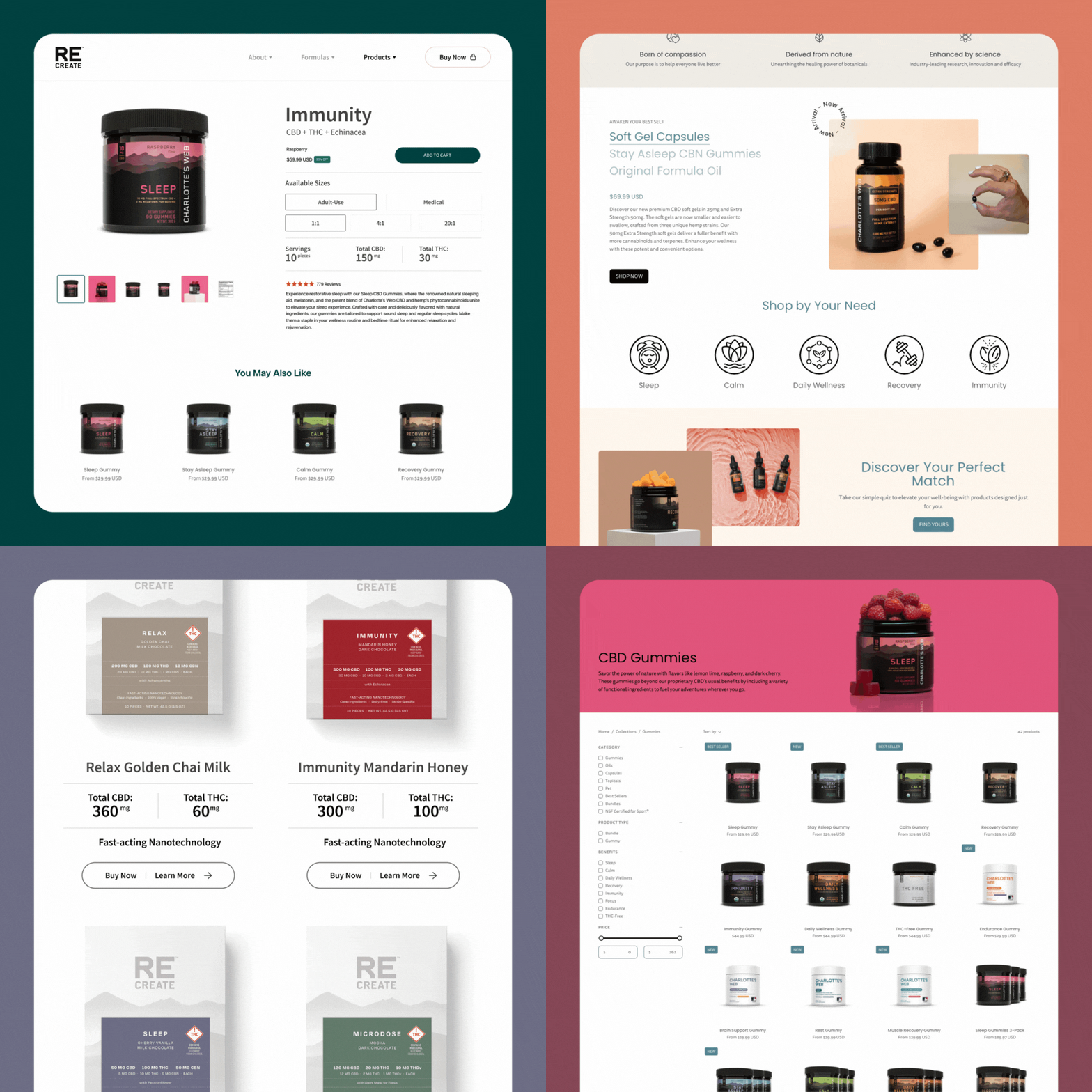
REcreate - eCommerce - Dynamic product card implementation
REcreate - eCommerce - Product detail page for CBD gummies
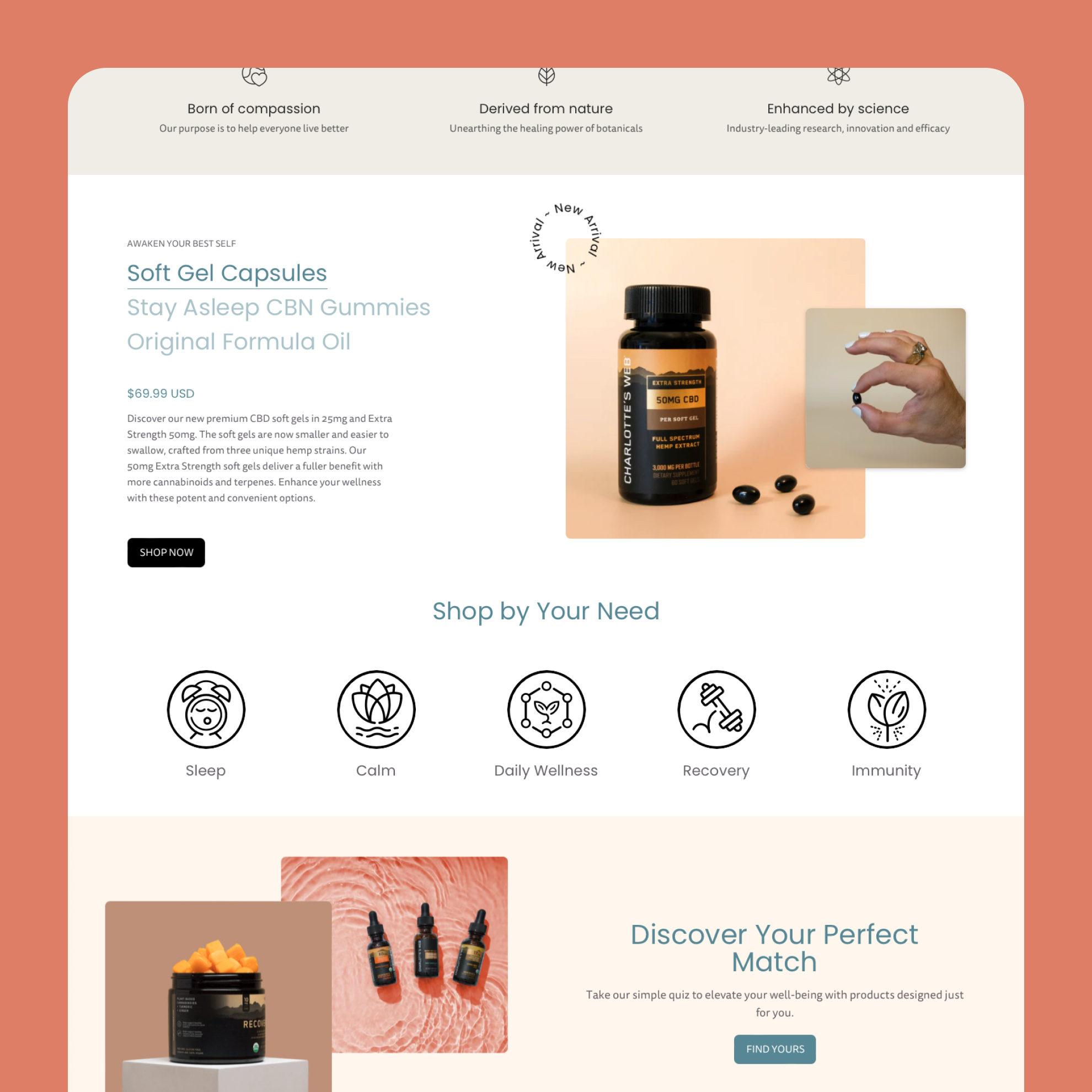
REcreate - eCommerce - Headless e-commerce homepage implementation
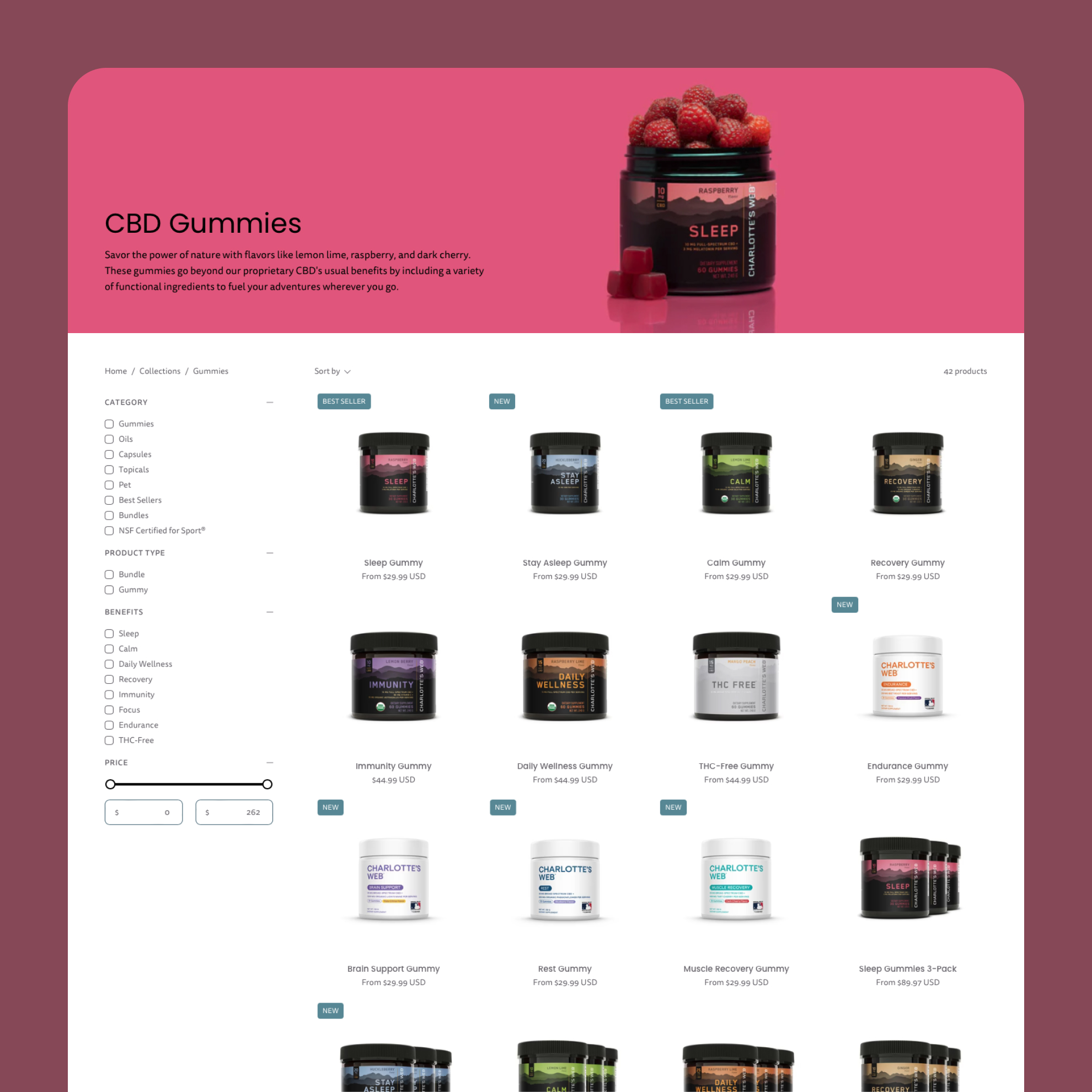
REcreate - eCommerce - Headless category page with dynamic filtering
No items found.
Bringing these clean product comparison cards to life on a headless stack. Each card is a reusable front-end component that pulls data directly from a 'Product' custom type we configured in Prismic. We set up specific fields for key specs like CBD/THC content and unique features, which are fetched via API. This allows for effortless updates and the creation of new curated collection pages on the fly.
To optimize the path to purchase, the Product Detail Page was strategically engineered around a core principle of conversion-centric design. We implemented a clean information architecture that elevated critical purchase drivers—such as the product gallery and dynamic attributes like size and dosage—to prime engagement zones, thereby accelerating the customer's decision-making process. Social proof mechanisms were seamlessly integrated to build consumer trust and validate choice, while the entire user journey was meticulously mapped to create a frictionless funnel toward the primary call-to-action. Finally, an integrated product discovery component was leveraged to increase average order value and deepen user engagement with the broader product ecosystem.
Here’s the homepage we implemented for wellness brand REcreate, using Prismic as the headless CMS. We structured the page using dynamic Slices, allowing the client to easily update the hero, featured products, and the "Shop by Your Need" section without any code. This approach gives their marketing team full content control while maintaining a lightning-fast and fully custom front-end experience.
This is our implementation of the product listing page (PLP), fully powered by Prismic. We integrated the front-end with Prismic's API to pull the product catalog and built out the filtering logic. Product benefits and categories are managed as a flexible taxonomy in the CMS, allowing for dynamic and accurate filtering. We also implemented data fields for promotional tags like 'New' and 'Bestseller,' giving the client easy control over product merchandising.

The brief

REcreate came to atQuo as Charlotte's Web's move into performance wellness — a new sub-brand targeting a younger, more active audience with CBD products built around recovery and lifestyle. The platform needed to reflect that positioning without losing the trust signals that Charlotte's Web had spent years building as a Certified B Corporation in a scrutinized category.

The technical requirement was a headless eCommerce site with Prismic as the CMS — giving the client full content control over a completely custom front-end, without the performance compromises of a monolithic platform.

The architecture decision

Headless was the right call for several reasons. Charlotte's Web operates in a regulated product category where content changes happen frequently — compliance language, product specs, promotional messaging. A marketing team that has to route every update through a developer isn't a viable operation at their scale. Prismic's slice-based architecture made it possible to build a front-end that was both completely custom and entirely editable by non-technical staff.

The product catalog itself required a specific content model. CBD and THC percentages, dosage options, benefit-based categorization, promotional flags — all of it needed to be structured as discrete fields in Prismic so that filtering, sorting, and merchandising could work reliably without manual workarounds.

What we built

The product comparison cards are reusable front-end components that pull directly from a Product custom type configured in Prismic. Key specifications — CBD content, unique features, format — are discrete fields fetched via API, which means the client can add new products or update existing ones without rebuilding any page structure.

The product detail page was engineered around the decision a wellness buyer actually makes. The gallery and dynamic attributes — size, dosage, format — are elevated to prime engagement zones. Social proof sits directly within the purchase flow rather than at the bottom of the page. A cross-sell component at the end drives deeper catalog engagement and increases average order value.

The homepage is built on Prismic Slices, which means every major section — the hero, featured products, the "Shop by Your Need" category navigation — can be updated, reordered, or replaced from the CMS without a code deployment. For a marketing team running seasonal campaigns and product launches, that autonomy is the actual product.

The product listing page integrates with Prismic's API to pull and filter the catalog dynamically. Benefit categories and product types are managed as a flexible taxonomy in the CMS. Promotional tags — "New," "Bestseller" — are data fields the client controls directly, which gives them merchandising flexibility without developer dependency.

The outcome

A headless eCommerce platform that gives Charlotte's Web the performance and flexibility their category demands, and a marketing team that can operate it independently — updating content, managing the catalog, and running campaigns without waiting on engineering.

Keep| reading, browsing, paging

Our case studies unite high-performance design and tangible results.
Ready to get started?

Deploy your stack

Whether you need to invent the future (Human Layer) or scale the present (Efficiency Layer), the infrastructure is ready.
[ Let's talk → ]

Need something else from the atQuo infrastructure?

Enter frontier layer
(You are here)
Relia
Integrated Teams